Marketing Hotline:
(+86)0532-88988868
(+86)0532-88988868
Fine chemicals, electronic semiconductors, pharmaceuticals and food, electroplated circuit boards... Every step of production relies on pure water. However, the industrial pure water machines on the market are varied, with models and parameters that are dazzling. Which one is actually suitable for you?
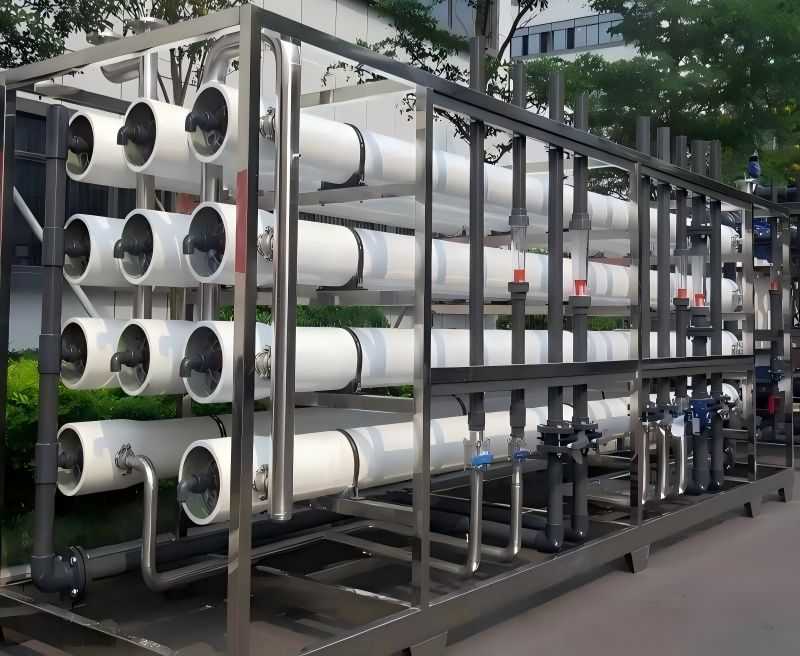
When choosing an industrial pure water machine, you don't need to blindly follow trends, look at brands, or compare prices. Focus on the core logic—matching your own production needs—so you can accurately avoid pitfalls and take fewer detours!
The core structure of an industrial pure water machine: a complete industrial pure water machine relies on three major core systems, which are also key to ensuring water quality. A must-read for beginners.
✅ Pretreatment System: Equivalent to the 'first line of defense' of a pure water machine, it filters out silt, impurities, residual chlorine, etc., from the raw water, preventing clogging of subsequent core components and extending the equipment's service life;
✅ Fine Treatment System: The core purification stage, deeply removing ions and organic matter from the water through processes such as reverse osmosis, and is the key factor determining water purity;
✅ Post-Treatment System: Further optimizes water quality to ensure that the output water meets the specific water standards of certain industries, catering to precise needs in different production scenarios.
Industrial pure water machines have no 'best,' only 'most suitable.' By considering these four dimensions, you can find the one that suits you.
PART 01 Consider the Usage: Identify the Scenario to Avoid Buying the Wrong Type
First, you need to be clear about your usage scenario. Different scenarios correspond to different types of pure water machines, so don’t get them confused!
▪ Laboratory pure water machine: Suitable for scientific experiments, focusing on small flow and high purity to meet precise experimental requirements;
▪ Industrial pure water machine: Suitable for small to medium-scale industrial production, such as small-scale electroplating or food processing, balancing flow and purity;
▪ Large-scale industrial pure water machine: Suitable for large-scale production, such as electronics semiconductors or large chemical plants, offering high flow, continuous operation, and supporting batch water production.
PART 02 Assess Usage: Choose as Needed, Balancing Convenience and Cost
According to your own operation and maintenance capabilities and budget, select the appropriate operation type. Each of the three types has its advantages
▪ Manual (Economical): High cost-effectiveness, uses manual backwash valves, simple operation, suitable for small enterprises with limited budgets and sufficient maintenance personnel;
▪ Automatic: Fully controlled by a computer control board, enabling automatic flushing and water production without the need for dedicated personnel, saving labor, suitable for medium to large enterprises;
▪ Self-Cleaning: Comes with self-cleaning function, uses self-cleaning reverse osmosis series, reduces frequency of manual maintenance, lowers operation and maintenance costs, suitable for scenarios requiring high equipment stability.
PART 03 Considering the Water Usage: Customizing Purity to Meet Industry Standards
Different industries have vastly different requirements for the purity of purified water, with the core factor being water resistivity (1–18.2 MΩ·cm), which can be customized as needed:
For example, in electronics, semiconductors, and the optical industry, high-purity water is required (resistivity close to 18.2 MΩ·cm) to prevent impurities from affecting product precision; while for ordinary food processing and electroplating water, the resistivity can be customized according to industry standards, without excessively pursuing high purity, thereby saving costs.
PART 04 Monitoring Water Usage: Customize According to Needs to Avoid Waste
Many companies easily fall into pitfalls: blindly purchasing high-flow equipment, which leads to energy waste; or buying equipment that is too small, which cannot meet production demands.
Key Reminder: The conductivity of pure water changes over time, and its purity decreases. Therefore, it is best to customize the size of the equipment based on the actual hourly water usage, ensuring timely water production and stable purity, avoiding energy waste while meeting essential production needs.
When choosing an industrial-grade purified water machine, there is no need to worry about 'which one is the best.' The key is to focus on four points: purpose, usage conditions, water purity, and water consumption. By combining these with your own production scale and industry standards, you can customize suitable equipment that not only meets production needs but also saves costs and reduces trouble.